
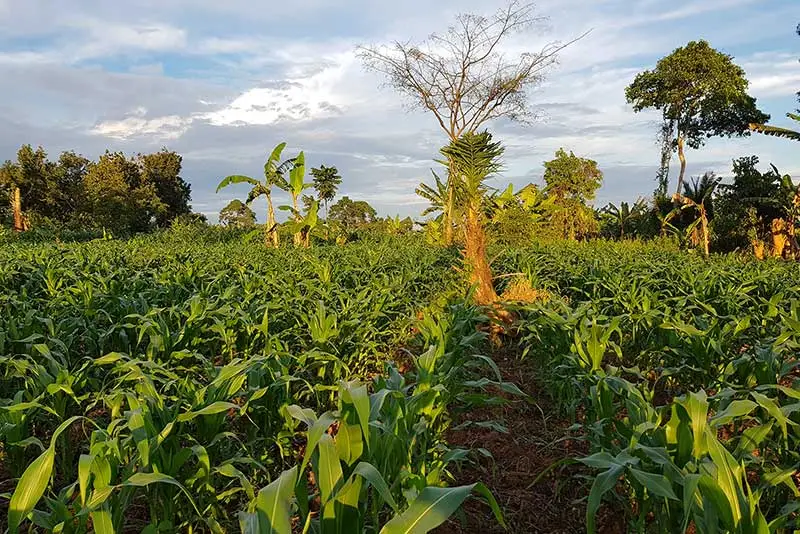
Almost every farmer knows trees would help. Far fewer plant them, because the field needs to produce this season and a tree gives nothing for years. Agroforestry is the practice of arranging trees so that they pay their way sooner.
What trees do on a farm
- Hold soil on slopes and reduce run-off.
- Shade soil and crops, lowering temperature and water loss.
- Fix nitrogen, in leguminous species, replacing purchased fertiliser.
- Produce fodder, cutting the labour of grazing.
- Produce fruit, fuel, poles and timber.
- Break wind, which reduces crop damage and drying.
- Support bees, which improves pollination.
Arrangements that work
Boundary planting. Trees along field edges and paths. Simplest to start with, no competition with the crop, and it marks the boundary.
Scattered trees in the field. Widely spaced trees among crops, pruned so shade stays light. The classic parkland arrangement.
Contour hedgerows. Lines of trees or shrubs along the contour on sloping ground, cut back regularly, the cuttings used as mulch. Strong erosion control.
Alley cropping. Rows of nitrogen-fixing shrubs with crops between, pruned several times a season and the leaves worked into the soil.
Fodder banks. A dense block of fodder species cut and carried to livestock.
Woodlots. A block for fuel and poles, keeping harvesting pressure off the rest of the farm.
Choosing species
Match the species to the job and to the site, and ask what already grows well nearby. In general:
- Nitrogen fixers for soil improvement and fodder.
- Fruit trees for nutrition and income: mango, pawpaw, guava, avocado, citrus.
- Fast-growing species for fuel and poles, kept in a woodlot rather than among crops.
- Indigenous species for durability and wildlife value.
Take care with species known to compete heavily with crops for water, or to be invasive. The district forestry officer can advise on what is appropriate locally, and that conversation is worth having before buying seedlings.
Planting
- Dig holes in advance and refill with topsoil and manure.
- Plant at the start of the rains, when moisture is reliable.
- Remove the polythene bag completely. Left on, it strangles the roots and the tree dies years later for no visible reason.
- Firm the soil, water in, and mulch.
- Protect from livestock with a guard. Unprotected seedlings among grazing animals will not survive.
The first two years
Survival is decided here. Weed around the base, mulch, water through unexpected dry spells, keep livestock off, and replace losses in the next rains. A survival rate of nine in ten is achievable with attention; without it, half is common.
Managing competition
Trees compete with crops for water, light and nutrients. Manage it by pruning to keep shade light, cutting back side branches that overhang crops, spacing generously in the field, and pruning roots on the crop side where a tree is drawing heavily.
The pruned material is not waste. It is mulch, fodder or fuel.
How many should I plant?
Plant a small number every season rather than a large number once. Twenty trees a year, well protected and mostly surviving, beats two hundred planted in one enthusiastic season of which thirty live. It also spreads the labour and the cost.
Do I need permission to cut trees I planted?
Rules on harvesting, particularly for indigenous species and for timber sale, vary and are enforced locally. Check with the district forestry officer before planting a species you intend to harvest commercially, so you understand the position before you have waited ten years.